Ask ten people to explain generative AI and you will get ten different answers. Some will say it predicts the next word. Others will say it thinks, or reasons, or understands. The truth sits somewhere between those extremes, and understanding it changes how you use these tools in your business.
So let’s settle the question properly. If you have ever wondered what is the primary goal of a generative AI model, the short answer is this: to learn the underlying patterns in a body of data well enough to produce new, original examples that could plausibly have come from that same data. Not to copy. Not to look things up. To generate.
Everything else—the chatbots, the image tools, the code assistants—is an application built on top of that single objective. If you want the applied view first, our roundup of AI in digital marketing covers where these systems are earning their keep right now.
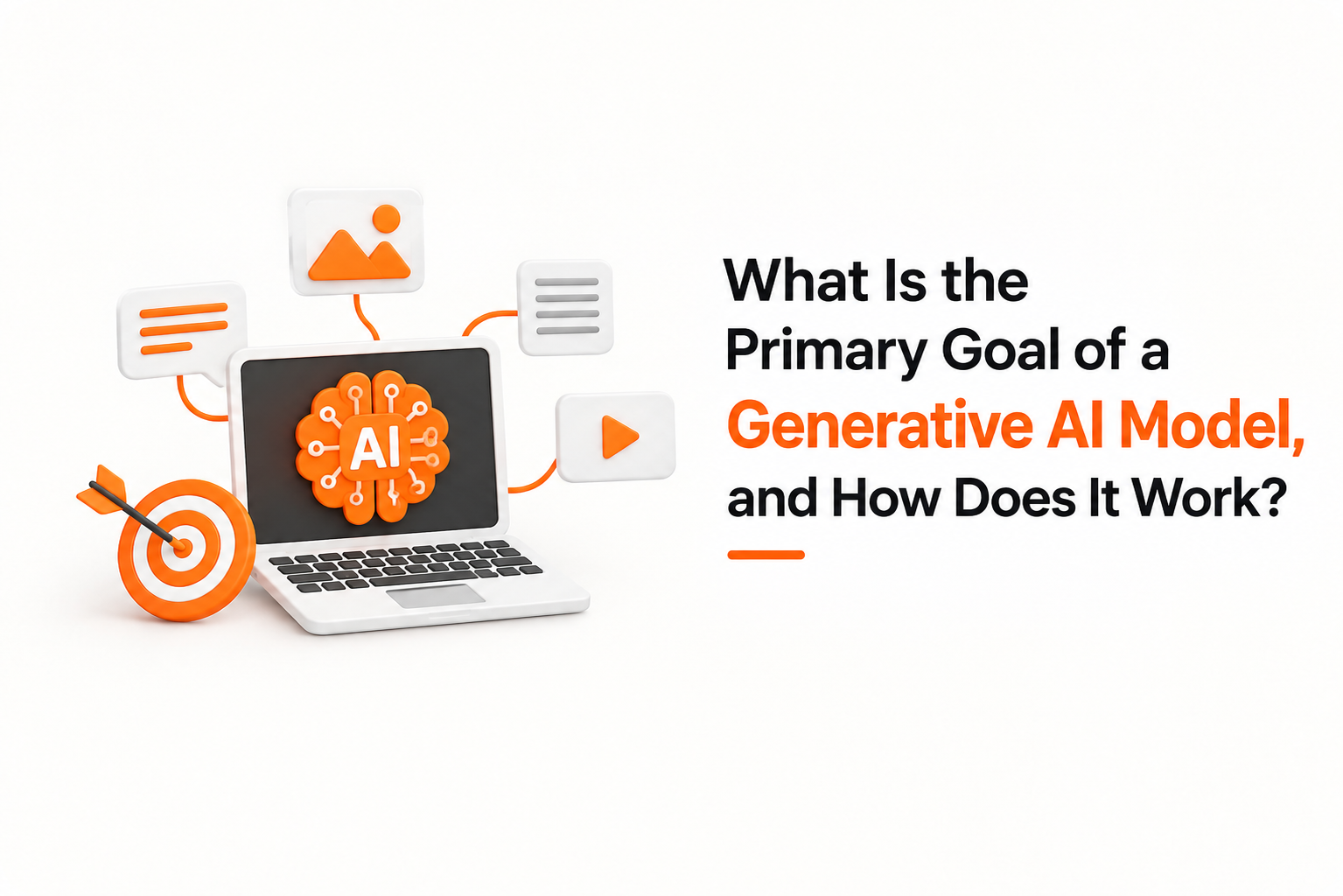
What Is the Primary Goal of a Generative AI Model?
The primary goal of a generative AI model is to model the probability distribution of its training data and then sample from it to create something new.
That sounds academic, so here is a plainer version. Imagine you read every recipe ever written. You would eventually absorb the patterns that cakes need a raising agent, that acid balances fat, and that curries build flavor in layers. You could then invent a recipe nobody has ever cooked, and it would still feel like a real recipe. You are not retrieving anything. You are generating from a learned structure.
A generative model does exactly this, at an enormous scale and with mathematics instead of intuition. Traditional AI models were built to discriminate, to sort an email into spam or not spam, and to flag a transaction as fraud. Generative models were built to create. That distinction is the heart of the matter.
It also explains the technology’s biggest quirk. Because the goal is plausibility rather than factual retrieval, a model can produce a confident answer that is completely wrong. It is doing its job generating something that fits the pattern even when the output is false.
How Does a Generative AI Model Actually Work?
Two phases matter: training and generation.
Training: Where the Primary Goal of a Generative AI Model Is Established
During training, the model is shown vast quantities of data—text, images, audio, and code—given a deceptively simple task. For language models, that task is usually to predict the next token (roughly, the next word or word fragment) in a sequence.
The model makes a guess. It compares the guess to the actual next token. It measures the error, then adjusts millions or billions of internal parameters to make the error slightly smaller. Then it does this again. And again. Billions of times.
Nobody programs grammar rules into the system. Nobody writes a definition of sarcasm or a description of what makes a good headline. Those patterns emerge on their own because getting them right reduces prediction error. This is why scale has mattered so much: bigger models trained on more data pick up subtler structure.
Generation: Turning Patterns Into Output
Once trained, the model runs in reverse, so to speak. You give it a prompt. It calculates a probability for every possible next token, picks one, adds it to the sequence, and repeats each new token informed by everything that came before.
A setting called temperature controls how adventurous that picking gets. Low temperature makes the model choose the most likely option almost every time, producing safe, predictable output. Higher temperature lets it reach for less obvious choices, which reads as creativity but also increases the chance of drift. Getting that balance right is a large part of why some AI chatbots for customer engagement feel natural while others feel unhinged.
The architecture underneath most modern systems is the transformer, introduced by Google researchers in 2017. Its key innovation, the attention mechanism, let the model weigh the relevance of every part of the input against every other part. That is how it keeps track of context across long passages and why it can follow a thread through a two-thousand-word document rather than losing the plot after a sentence.
The Main Types of Generative Models
Different architectures pursue the same goal through different routes:
- Transformers power large language models like GPT, Claude, and Gemini. Best for text, code, and increasingly multimodal work.
- Diffusion models underpin image generators such as Midjourney and Stable Diffusion. They start with pure noise and refine it step by step until an image emerges.
- GANs (Generative Adversarial Networks) pit a generator against a discriminator; one creates fakes, and the other spots them until the fakes become convincing.
- VAEs (Variational Autoencoders) compress data into a compact representation, then reconstruct variations from it.
Same underlying objective. Very different engineering.
Why This Matters for Your Business
Understanding what is the primary goal of a generative AI model is not trivia. It directly shapes how you should deploy these tools.
Verify anything factual. The model optimizes for plausibility, not truth. Statistics, dates, client names, legal claims, and pricing check every one.
Use it where variation is the point. Ad copy variants, subject lines, first drafts, brainstorming, and code scaffolding. Tasks where generating many options quickly beats getting one perfect answer, which is precisely why it fits so neatly into the lead generation strategies most teams are already running.
Give it rich context. Output quality tracks input quality closely. A vague prompt gets a generic response because “generic” is statistically the safest answer. Feed it your brand voice, audience details, and constraints, and the output sharpens dramatically.
Keep a human in the loop. The model has no stake in your reputation. You do.
The commercial case is no longer theoretical either. Conversational tools built on this technology qualify interest at the exact moment a visitor is paying attention, which is why AI chatbots are increasing lead generation rather than simply deflecting support tickets.
At Buzzing Brands, we see the difference constantly. Teams that treat generative AI as an oracle get mediocre results and lose trust in the tool. Teams that treat it as a fast, tireless first-draft engine with editorial judgement applied on top ship better work in a fraction of the time.
The Limits Worth Knowing
Generative models have no memory beyond the current conversation unless you build one. They have a training cutoff, so recent events may be unknown to them. They can absorb and repeat biases present in their training data. And they cannot tell you how confident they are in any meaningful way; fluency and accuracy are separate things.
None of this makes the technology less useful. It makes it a tool with a shape, like every other tool. It does, however, change where discovery happens when a model writes the answer your customer reads; SEO in ai search becomes a different discipline from classic SEO.
Final Thoughts
So, what is the primary goal of a generative AI model? To learn the structure of data deeply enough to create convincing new examples of it. Prediction at scale turned into creation.
Once that clicks, the rest of it—the strengths, the failure modes, the prompting techniques that actually work—stops feeling like magic and starts feeling like engineering you can plan around. Understanding the mechanism is step one. make your business visible in AI is step two.
If you want help building generative AI into your content, SEO, or paid media workflow without sacrificing quality or brand voice, contact Buzzing Brands. We build systems that use the technology for what it is genuinely good at. And if you are still weighing up partners, our take on choosing a digital marketing agency in India is a useful place to start.
Frequently Asked Questions
1. What is the primary goal of a generative AI model in simple terms?
Its goal is to study patterns in large volumes of data and then produce new content that follows those same patterns. It is creating output based on learned structure, not retrieving stored answers from a database.
2. How is generative AI different from traditional AI?
Traditional AI models are mostly discriminative; they classify, sort, or predict a label, such as marking an email as spam. Generative AI creates entirely new content: text, images, audio, video, or code.
3. Why does generative AI sometimes give wrong answers?
Because the model is optimized to generate plausible output, not verified facts. When it lacks reliable information, it still produces the most statistically likely sequence, which can sound authoritative while being incorrect. This is commonly called hallucination.
4. Do generative AI models actually understand what they create?
Not in the human sense. They model statistical relationships between elements in their training data extremely well. Whether that amounts to a form of understanding is an open debate among researchers, but it is not comprehension the way a person experiences it.
5. How can businesses use generative AI effectively?
Use it for tasks where speed and volume of options matter: drafting, ideation, variations, summaries, and code scaffolding. Provide detailed context in your prompts, and always have a human review factual claims and brand-sensitive material before publishing.