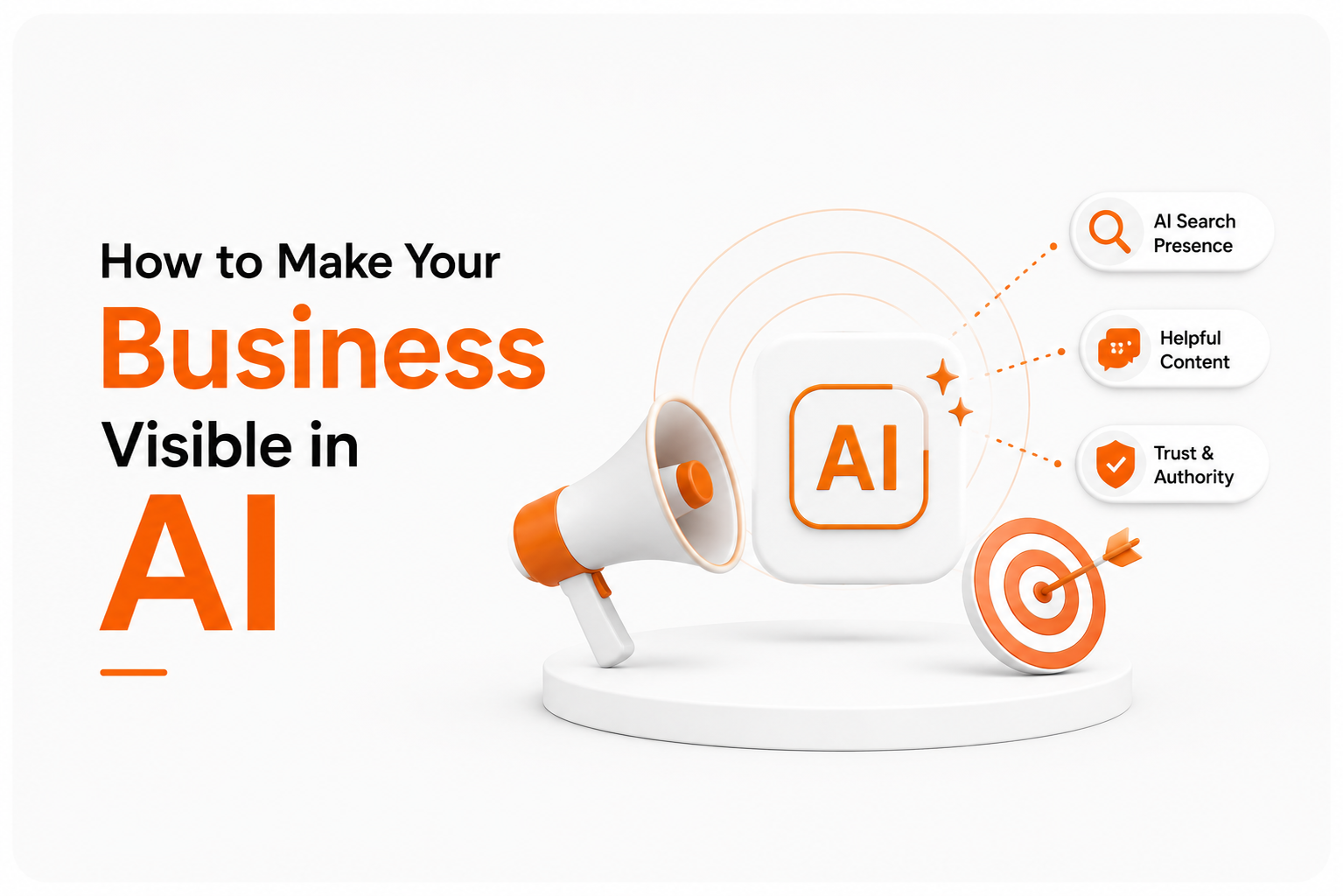
The way people search for products, services, and recommendations has changed for good. Instead of typing a query into Google and scrolling through ten blue links, millions of users now simply ask ChatGPT, Gemini, or Google’s AI Overviews a direct question and expect a direct answer. If your business isn’t part of that answer, you’re invisible at the exact moment a potential customer is ready to choose.
This shift means business owners and marketers can no longer rely on traditional SEO alone. Learning how to make your business visible in AI has become just as important as ranking on page one of Google. In this guide, we’ll break down exactly what it takes to get your brand noticed, cited, and recommended by today’s leading AI platforms.
Why It’s Important to Make Your Business Visible in AI
AI-powered search tools don’t just list websites they read, summarize, and synthesize information from multiple sources to generate a single, conversational answer. If your content isn’t structured or trustworthy enough to be part of that synthesis, you simply won’t show up, no matter how well you rank in traditional search results.
For small and mid-sized businesses, this is both a challenge and an opportunity. Larger competitors haven’t fully mastered AI visibility yet, which means there’s still room to establish authority early. Businesses that focus now on how to make business visible in AI platforms will have a significant head start as this becomes the default way people discover brands online. This is closely tied to how AI chatbots are increasing lead generation, since visibility in AI-driven conversations is often the first touchpoint that turns a curious searcher into a qualified lead.
How Search Behavior Has Shifted Toward AI Platforms
Search used to be a list of options for users to sift through. Now, AI assistants act more like a knowledgeable friend who has already read everything and hands you the single best answer. This is a fundamental shift in how discovery works, and it changes what businesses need to optimize for. If you want a broader look at how this shift is reshaping strategy across the board, our guide on AI in digital marketing breaks down what’s changing beyond just search.
Each platform works a little differently:
- ChatGPT often relies on Bing’s index for browsing-based answers and rewards content with clear structure, credible citations, and comprehensive coverage of a topic.
- Gemini is closely tied to Google’s existing trust signals, including your Google Business Profile, backlinks from authoritative sites, and structured data.
- Google AI Overviews favor content that answers a query directly within the first few lines, with strong formatting and clear expertise signals.
Understanding these differences is the first step toward building a strategy that works across all three, rather than chasing one platform at a time.
Practical Steps to Make Business Visible in AI
1. Build a Clear, Well-Defined Business Entity
Before AI systems can recommend your business, they need to understand exactly what it is, what it does, and who it serves. This starts with consistent information across your website, Google Business Profile, social media, and any directories you’re listed in. Vague descriptions or inconsistent business names and addresses confuse AI systems just as much as they confuse human readers.
To genuinely make business visible in AI results, treat entity clarity as a foundation, not an afterthought. Use consistent naming, clear service descriptions, and a well-organized “About” page that spells out who you are and what problem you solve. Local businesses in particular benefit from getting this right early. Our guide to digital marketing for Bangalore businesses covers how to strengthen your local entity signals alongside your broader marketing strategy.
2. Publish Content That Answers Real Questions
AI platforms are designed to answer questions, so the content most likely to be pulled into an AI response is content that’s already structured around questions. Instead of writing generic pages, build content around the exact questions your customers are asking.
Use question-based headings, followed by a direct two-to-three-line answer, and then expand with useful detail. This format makes it easy for AI tools to extract a clear, quotable answer while still giving human readers depth if they want it.
3. Add Structured Data and Schema Markup
Structured data gives AI systems explicit, machine-readable signals about your content. Implementing FAQ schema, HowTo schema, and Organization schema helps platforms like Gemini understand your page architecture more accurately, which increases the odds your content gets surfaced in an AI-generated answer.
This is one of the more technical steps businesses take to make business visible in AI search, but it’s also one of the most effective, since it removes ambiguity for the systems parsing your site.
4. Earn Trust Signals and Third-Party Mentions
AI doesn’t trust content in a vacuum. It looks for external validation — reviews, backlinks from reputable sites, mentions in industry publications, and consistent citations across the web. A single mention in a respected publication often carries more weight than dozens of low-quality links.
Encourage satisfied customers to leave reviews, pursue guest posts or mentions on industry sites, and make sure your team’s expertise is visible on platforms like LinkedIn, where named professionals posting in their own voice add credibility to your brand’s overall footprint. Responsive, well-managed AI chatbots for lead generation on your own website also help, since positive on-site interactions often translate into the kind of reviews and word-of-mouth that build long-term trust signals.
5. Keep Your Website Technically Accessible
None of your content matters if AI crawlers can’t access it. Check your robots.txt file, ensure your site is indexed properly in Google Search Console and Bing Webmaster Tools, and confirm your pages load quickly on mobile devices. Slow-loading pages don’t just frustrate visitors; they can also hold back crawling and indexing, so it’s worth understanding page loading speed for website performance before AI platforms decide your site isn’t worth surfacing. ChatGPT’s browsing capability is powered by Bing’s index, so if you’re missing from Bing, you’re likely missing from a meaningful share of ChatGPT’s answers too.
6. Keep Content Fresh and Updated
AI systems, especially those with browsing capability, favor current information over stale pages. Add a visible “last updated” date to your most important pages, and revisit them regularly with new examples, updated statistics, or expanded sections. This signals to AI platforms that your content is actively maintained rather than abandoned.
7. Track What AI Platforms Already Say About You
Before investing further, find out what ChatGPT, Gemini, and other assistants currently say about your business. Ask them directly what they know about your company and your industry category. Most businesses discover the answers are a mix of outdated, incomplete, or even inaccurate information, which gives you a clear starting point for correction and improvement.
Common Mistakes That Hurt AI Visibility
Even well-meaning businesses often make missteps that quietly work against their AI visibility goals:
- Inconsistent business information across the web, which confuses entity recognition.
- Thin or generic content that doesn’t directly answer real user questions.
- Ignoring technical SEO, including crawlability, site speed, and indexing.
- Neglecting reviews and third-party mentions, which are key trust signals for AI systems.
- Treating this as a one-time project instead of an ongoing content and authority-building effort.
Avoiding these mistakes is just as important as implementing the right strategies if you want to consistently make business visible in AI platforms over time.
How Long Does It Take to See Results?
Patience matters here. Technical changes like schema implementation or fixing crawler access issues can produce measurable improvements within a few weeks, since search engines re-crawl and re-index regularly. Content-driven improvements take longer; a new blog post or FAQ page typically needs several weeks before it’s crawled, indexed, and incorporated into AI responses with any real frequency. Building genuine topical authority through a full content cluster can take several months.
The businesses that succeed are the ones that treat AI visibility as an ongoing discipline, not a one-time checklist.
Final Thoughts
AI-powered search is no longer a future trend; it’s how a growing share of your potential customers are discovering businesses right now. Learning how to make business visible in AI platforms like ChatGPT, Gemini, and Google AI Overviews requires a shift in mindset: from chasing rankings to earning trust, from generic content to answer-focused content, and from one-time optimization to ongoing authority building.
Start with the fundamentals: a clear business entity, well-structured content, solid technical accessibility, and genuine third-party trust signals, and build from there. The businesses that invest in this now will be the ones AI assistants confidently recommend for years to come. If you’d rather have experts handle the groundwork, our team offering SEO services in Bangalore can help you build the technical and content foundation needed to show up across both traditional and AI-powered search.
If you found this guide helpful, share it with a fellow business owner who’s still relying on old-school SEO alone, and check back for more insights on staying visible in the age of AI search. For more expert insights and hands-on support with your digital growth, explore what Buzzing Brands has to offer.
Frequently Asked Questions
1. What does it mean to make your business visible in AI?
It means optimizing your website, content, and online presence so that AI platforms like ChatGPT, Gemini, and Google AI Overviews can find, understand, and confidently recommend your business in their generated answers.
2. Is AI visibility different from traditional SEO?
Yes, though they overlap. Traditional SEO focuses on ranking in search results, while AI visibility (often called GEO, or Generative Engine Optimization) focuses on getting your content cited and referenced within AI-generated answers.
3. How long does it take to improve AI visibility?
Technical fixes can show results within a few weeks, but content-driven improvements and topical authority typically take a few months of consistent effort to fully take effect.
4. Does Google Business Profile affect AI visibility?
Yes, especially for Gemini and Google AI Overviews, which often pull local business information directly from an active and well-maintained Google Business Profile.
5. Can small businesses compete with larger brands in AI search?
Absolutely. Since AI visibility is still a relatively new discipline, small businesses that focus early on clear content, structured data, and trust signals can establish authority before larger competitors fully catch up.