Creating content is easy. Creating content that consistently attracts the right audience, earns visibility in search results, and generates business results requires a well-planned SEO content strategy.
Many businesses publish blogs regularly but struggle to gain organic traffic because their content is not aligned with search intent, keyword opportunities, audience needs, or Google’s quality signals. A successful content strategy goes beyond inserting keywords into articles. It involves understanding what your audience searches for, creating useful content around those needs, optimizing it properly, and continuously improving performance.
Whether you are a startup, e-commerce business, service provider, or established brand, a strong SEO content strategy can help build organic visibility and establish your website as a reliable source of information.
What Is an SEO Content Strategy?
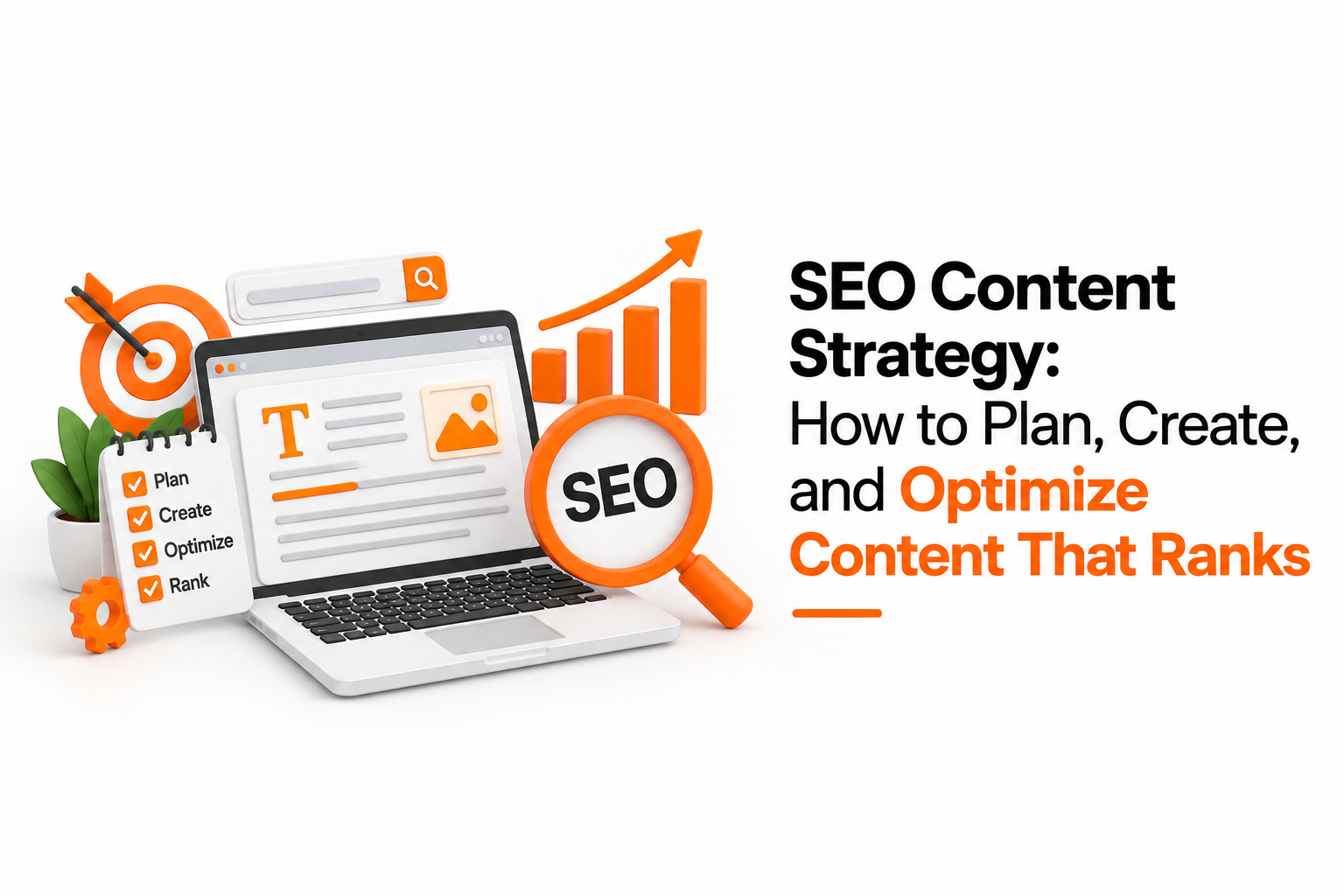
An SEO content strategy is a systematic approach to planning, creating, optimizing, publishing, and improving website content to increase organic search visibility. It connects three important elements: your business goals, your audience’s search behavior, and search engine requirements.
A good strategy typically includes:
- Keyword and search intent research
- Topic and content planning
- Competitor analysis
- Content creation
- On-page SEO optimization
- Internal linking
- Content promotion
- Performance tracking and optimization
Instead of randomly publishing blog posts, an SEO-driven strategy helps you create content with a specific purpose and measurable objective.
Why Is an SEO Content Strategy Important?
Search engines have become more sophisticated. Simply targeting a keyword repeatedly is no longer enough to achieve sustainable rankings. A well-planned SEO content strategy helps businesses create content that answers real questions and matches what users are looking for.
It can help you:
- Increase organic website traffic
- Target relevant search queries
- Improve topical authority
- Generate qualified leads
- Support product and service pages
- Build brand credibility
- Improve user engagement
- Create long-term organic visibility
SEO should also be considered alongside other digital marketing channels. If you are deciding between organic search and social media, understanding SEO vs SMM can help you determine how content should fit into your overall marketing strategy.
How to Build an SEO Content Strategy
Developing an effective strategy requires more than choosing a few keywords. Follow a structured process to make your content more purposeful and competitive.
1. Define Your SEO and Business Goals
Start by determining what you want your content to achieve. Your objective could be increasing organic traffic, generating leads, improving brand awareness, supporting a service page, or increasing e-commerce sales. For example, a B2B company may focus on lead generation, while an e-commerce website may prioritize product discovery and category visibility. Clearly defined goals help determine which topics you should create and how success should be measured. If your broader objective is to strengthen your online presence, it is also useful to understand the types of digital marketing and how SEO works alongside other acquisition channels.
2. Understand Your Target Audience
Before conducting keyword research, understand who you are creating content for.
Identify:
- Their problems and challenges
- Questions they frequently ask
- Products or services they are researching
- Their buying stage
- The terminology they use when searching online
Creating detailed audience personas can help you produce content that addresses genuine needs rather than simply targeting high-volume keywords.
3. Conduct Keyword Research
Keyword research is a fundamental part of an SEO content strategy. Look for keywords based on search volume, competition, relevance, and user intent. Don’t focus exclusively on high-volume keywords. Long-tail keywords can often attract highly relevant visitors and have stronger conversion potential.
Organize keywords into categories such as
- Informational keywords
- Commercial investigation keywords
- Transactional keywords
- Navigational keywords
- Local search keywords
For example, someone searching for “what is SEO” is probably looking for information, while someone searching for “SEO agency in Bangalore” may already be considering a service provider.
4. Analyze Search Intent
Search intent describes the reason behind a user’s search. Before creating content, search your target keyword and analyze the results appearing on Google. Look at the type of content ranking, the questions being answered, the content depth, and the format being used. If most results are comprehensive guides, creating a short 300-word article may not satisfy the same intent. Your content should provide a better or more useful answer while maintaining originality and relevance.
5. Create High-Quality, Helpful Content
Once your topics and keywords are finalized, focus on creating content that genuinely helps the reader. Avoid writing articles solely to meet a word count. A 1,000-word article with useful insights is more valuable than a 2,000-word article filled with repetition.
Strong content should:
- Answer the primary question clearly
- Provide actionable information
- Use relevant examples
- Have logical headings and subheadings
- Be easy to scan
- Include accurate information
- Address related questions
- Offer a clear next step
Your content should demonstrate experience and understanding rather than simply summarizing information available elsewhere.
6. Optimize On-Page SEO Elements
Include your primary keyword naturally in important locations such as
- Page title
- H1 heading
- Relevant H2 and H3 headings
- Introduction
- Body content
- Meta title
- Meta description
- URL, where appropriate
- Image alt text, when relevant
However, avoid keyword stuffing. Search engines can understand related terminology and context, so use semantic and supporting keywords naturally throughout the article. SEO practices continue to evolve, so your content strategy should also account for changing search behavior. Reviewing the latest SEO trends can help you identify areas where your existing strategy may need to adapt.
7. Strengthen Internal Linking
Internal links connect related pages on your website. For example, a blog about SEO content strategy could link to related resources covering SEO services, keyword research, technical SEO, or digital marketing. Internal linking helps users navigate your website and allows search engines to discover and understand relationships between your pages. Use descriptive anchor text rather than generic phrases such as “click here.” Internal links can also guide users from informational content toward commercial pages. For example, businesses looking for professional assistance can explore SEO services in Bangalore after learning how an effective content strategy works.
8. Optimize for Featured Snippets and AI Search
Search behavior is evolving beyond traditional blue-link results. Users increasingly expect direct answers from search engines and AI-powered search experiences. This makes optimization for answer-focused search increasingly important. Businesses should consider how their content can provide concise, accurate, well-structured answers that are useful across traditional search and AI-powered platforms. You can learn more about this approach in our guide to SEO in AI search. Structure your content to make important information easy to understand and extract.
Use:
- Clear definitions
- Concise answers
- Question-based headings
- Step-by-step instructions
- Bullet points
- Tables where appropriate
- FAQ sections
This approach can improve the usefulness of your content for both traditional search and answer-focused search experiences.
Measure and Improve Your SEO Content Strategy
Publishing content should not be the end of your process. Monitor performance using tools such as Google Search Console and Google Analytics. Track metrics including
- Organic clicks
- Impressions
- Keyword rankings
- Organic traffic
- Engagement
- Conversions
- Click-through rate
If an article receives impressions but few clicks, consider improving its title and meta description. If it receives traffic but does not generate conversions, review the search intent and calls to action. Content optimization should be an ongoing process rather than a one-time task.
How Long Does SEO Content Take to Show Results?
SEO is a long-term acquisition channel, and content typically needs time to be crawled, indexed, evaluated, and gain authority. The timeframe depends on factors such as website authority, competition, content quality, search intent, backlinks, technical SEO, and the competitiveness of the target keyword. For a more detailed understanding of the timeline, read our guide on how long SEO takes to show results. This is also why businesses should evaluate content performance over an appropriate period rather than expecting immediate results after publishing an article.
Build a Sustainable SEO Content Strategy
An effective SEO content strategy combines research, useful content, technical optimization, internal linking, and continuous measurement. The goal isn’t simply to publish more articles. It is to publish the right content for the right audience at the right stage of their search journey. If you’re considering professional SEO support, understanding factors such as how much SEO costs in India can help you evaluate potential budgets and services. For businesses comparing agencies, you can also explore what to look for when selecting the best SEO company in Bangalore, particularly when your goal is long-term organic growth rather than short-term traffic. With consistency and a strategic approach, content can become one of your website’s strongest long-term assets for organic traffic, authority, and business growth.
For more SEO, digital marketing, and content marketing insights, explore the Buzzing Brands website and discover practical strategies to strengthen your online presence.
FAQs
1. What is an SEO content strategy?
An SEO content strategy is a structured approach to researching, planning, creating, optimizing, and improving content to increase organic search visibility and attract relevant website visitors.
2. How do I create an effective SEO content strategy?
Start by defining your business goals, understanding your target audience, conducting keyword research, analyzing search intent, creating topic clusters, producing helpful content, optimizing on-page SEO, and tracking performance.
3. How often should I publish SEO content?
There is no universal publishing frequency. Quality, relevance, consistency, and search intent are more important than publishing a specific number of articles every month.
4. Why is search intent important for SEO content?
Search intent helps you understand what users expect when they enter a query. Matching your content with that intent increases its relevance and improves the likelihood of attracting and satisfying the right audience.
5. How long does it take for SEO content to rank?
The timeframe varies depending on competition, website authority, content quality, search intent, backlinks, and technical SEO. Some pages may gain visibility quickly, while competitive topics can take several months to establish strong rankings.