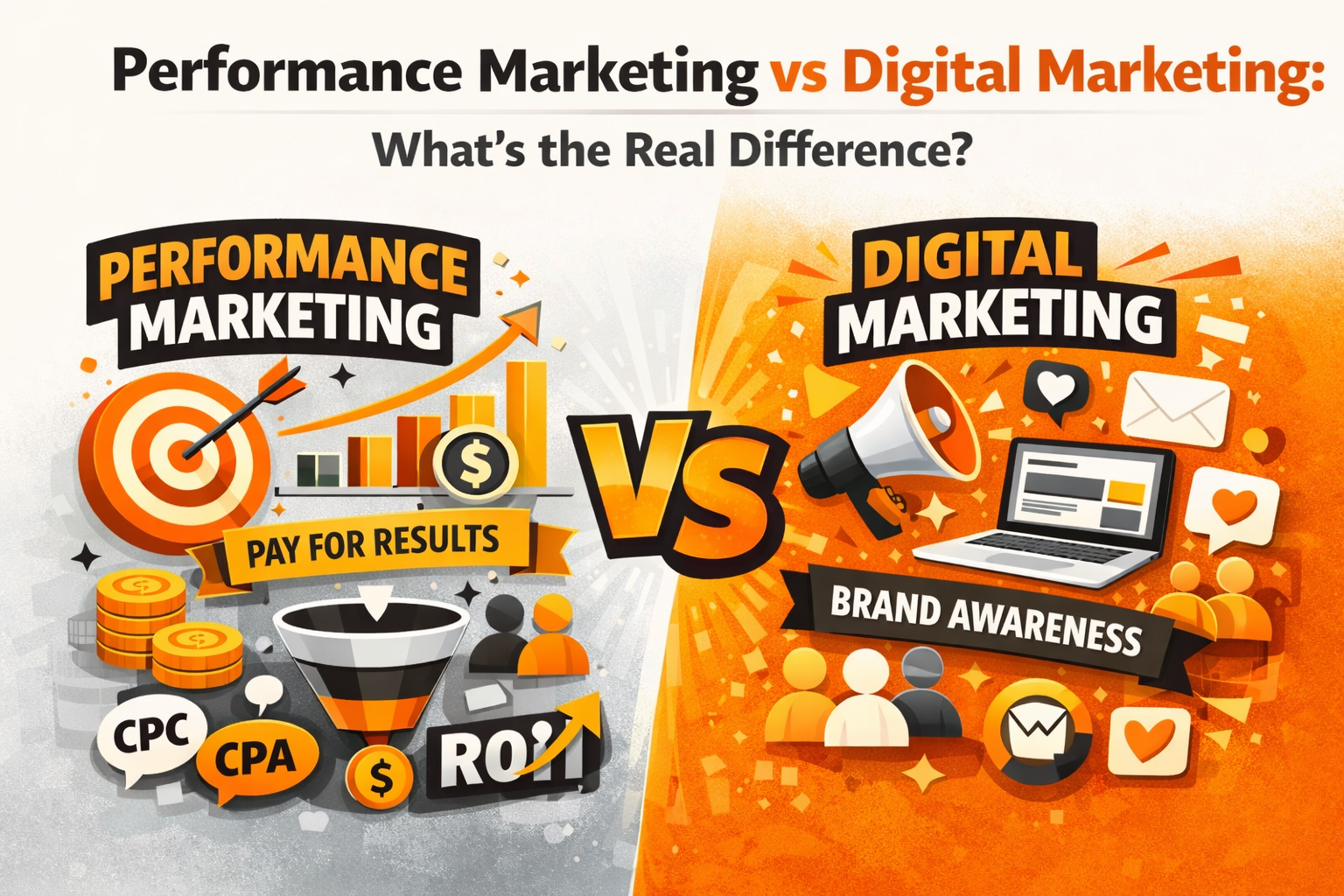
In today’s competitive online landscape, businesses often encounter two major terms performance marketing and digital marketing. While they are closely related, they serve different purposes.
Understanding the difference between performance marketing vs digital marketing helps businesses choose the right strategy based on their goals, budget, and timeline.
For businesses looking to implement measurable growth campaigns, exploring professional performance marketing services can provide clarity on how ROI-driven strategies actually work.
Quick Comparison Table: Performance Marketing vs Digital Marketing
| Aspect | Performance Marketing | Digital Marketing |
| Definition | Results-driven marketing where payment is based on specific actions (leads, sales, clicks). | Broad online marketing strategy covering all digital channels. |
| Scope | Subset of digital marketing. | Umbrella term including SEO, content, social, paid ads, email, etc. |
| Primary Focus | Conversions and measurable ROI. | Brand awareness, engagement, long-term growth. |
| Payment Model | Pay per result (CPL, CPA, ROAS). | Fixed budgets, retainers, or campaign-based spending. |
| KPIs | Cost per lead, cost per acquisition, conversion rate, ROAS. | Traffic, impressions, engagement, keyword rankings. |
| Speed of Results | Fast and measurable (short-term gains). | Gradual and long-term growth. |
| Budget Dependency | Requires continuous ad spend. | Organic strategies can reduce paid dependency over time. |
| Best For | Immediate leads, sales, product launches. | Brand building and sustained digital presence. |
Detailed Breakdown of Differences
1. Scope and Strategy
Digital marketing is the overall framework that includes multiple channels and strategies to promote a brand online. Performance marketing is a focused strategy within digital marketing that prioritizes measurable actions.
If you want to understand execution-level tactics, you can explore detailed insights on performance marketing strategies that work, which break down how structured campaigns deliver consistent ROI.
2. Objective and Outcomes
Digital marketing aims to build brand authority and audience engagement over time. Performance marketing, on the other hand, prioritizes direct conversions and ROI-driven outcomes.
For example, businesses aiming to generate high-quality leads often rely on paid campaigns such as Google Ads. A practical example can be seen in how Google AdWords helps businesses get more leads through intent-based targeting and conversion tracking.
3. Measurement and Accountability
Performance marketing campaigns are fully data-driven. Every click and conversion is tracked, making optimization easier.
Digital marketing includes measurable elements (like SEO rankings), but some benefits such as brand recall are harder to quantify.
4. Timeframe for Results
Performance marketing typically delivers faster results through paid advertising campaigns.
Digital marketing strategies like SEO and content marketing may take months but provide sustainable, long-term growth.
Which Strategy Should You Choose?
Instead of viewing it as performance marketing vs digital marketing, businesses should understand how they complement each other.
Choose Performance Marketing If:
- You need immediate leads or sales
- You want clear ROI tracking
- You are launching a new product or service
Choose Digital Marketing If:
- You want long-term brand authority
- You aim for organic search visibility
- You want sustainable audience engagement
The Smart Approach: Combine Both
The most successful businesses integrate both strategies:
- SEO and content marketing build long-term authority
- Social media increases brand engagement
- Paid ads drive immediate conversions
- Retargeting improves overall ROI
This hybrid approach ensures both short-term wins and long-term stability.
Common Mistakes Businesses Make
- Relying only on paid ads without brand building
- Investing only in SEO without lead generation
- Ignoring data tracking
- Scaling too quickly without optimization
Avoiding these mistakes improves both performance marketing and digital marketing outcomes.
Frequently Asked Questions (FAQs)
Frequently Asked Questions (FAQs)
1. What is the main difference between performance marketing and digital marketing?
Digital marketing is a broad strategy covering all online marketing activities, while performance marketing focuses strictly on measurable results like leads and sales.
2. Which is more cost-effective?
Performance marketing offers immediate, measurable ROI, while digital marketing reduces long-term dependency on paid ads.
3. Is performance marketing better for startups?
Yes, because it generates faster results and measurable growth.
4. Can digital marketing work without performance marketing?
Yes, but growth may be slower. Combining both delivers stronger results.
5. Should businesses use both strategies?
Yes. A combination ensures balanced short-term and long-term growth.
Conclusion: Performance Marketing vs Digital Marketing – The Smart Choice
The debate between performance marketing vs digital marketing isn’t about choosing one over the other—it’s about understanding their roles.
Digital marketing builds brand authority and long-term visibility. Performance marketing drives measurable, immediate results. Businesses that integrate both strategies create a balanced growth engine that delivers sustainable success.
If you want predictable leads today and strong brand authority tomorrow, combining performance marketing with digital marketing is the smartest approach.
Want predictable leads and sustainable online growth?
👉 Contact Buzzing Brands today and let’s build a strategy that delivers real results.