Every business investing in paid advertising eventually faces the same question: should your ad budget go into Google Ads or Meta Ads? Both platforms are powerhouses in the digital advertising world, yet they work in fundamentally different ways. Making the wrong call can cost you thousands in wasted spend. Making the right one can transform your ROI.
In 2026, the landscape has evolved and artificial intelligence is now embedded deeply in both platforms, targeting has grown more automated. In this blog let’s break down everything you need to know about Google Ads vs Meta Ads so you can make an informed, data backed decision for your business
What Are Google Ads and Meta Ads?
Before comparing the two, it helps to understand what each platform actually is and how it fits into the broader digital marketing ecosystem.
What is Google Ads?
Google Ads is Google’s online advertising platform that allows businesses to place paid ads across Google Search, YouTube, Gmail, Google Shopping, and the Google Display Network, a collection of millions of partner websites. Google Ads is fundamentally built around search intent: your ads appear when someone actively types a query into Google that matches your keywords.
In 2026, Google has significantly expanded its automation capabilities through Performance Max campaigns, which use machine learning to serve ads across all of Google’s inventory from a single campaign.
What are Meta Ads?
Meta Ads is the paid advertising platform that spans Facebook and Instagram and the Meta Audience Network. Rather than targeting by search intent, Meta Ads works by reaching people based on who they are, their interests, demographics, behaviours, and connections. Users on Meta platforms are not searching for anything; they are browsing, scrolling, and consuming content.
Meta’s platform has evolved considerably with the introduction of Advantage+ campaigns, which use AI to automate creative selection, audience expansion, and placements with minimal manual input.
If you’re new to paid advertising, you may also want to explore our complete guide to performance marketing in 2026 to understand how these platforms fit into a broader strategy.
Google Ads in 2026: The Power of Precision and Search Intent
As we move through 2026, Google Ads has moved far beyond simple keyword matching. The platform now relies heavily on “Search Generative Experiences” and AI-driven bidding strategies that predict user value in real-time.
The Strengths of Google Ads for ROI
- High Intent Traffic: Because Google Ads targets users based on specific search queries, the traffic is pre-qualified. You aren’t just reaching “people interested in shoes”; you are reaching “people looking to buy waterproof hiking boots today.” This is exactly why many businesses rely on Google to drive conversions — you can learn more about How Google Adwords help Business get more leads
- Granular Tracking and Attribution: Google’s ecosystem allows for precise measurement of how every penny is spent. With advanced conversion tracking, businesses can see the exact journey from a search query to a final purchase.
- Massive Reach via the Display Network: Beyond search, the Google Display Network allows brands to retarget users across millions of websites, keeping your brand top of mind after an initial search.
Challenges to ROI on Google Ads
The primary hurdle for Google Ads in 2026 is cost. In highly competitive industries like legal, insurance, or SaaS, the Cost Per Click (CPC) can be prohibitively high. If your campaigns are not structured properly, you could end up wasting a significant portion of your ad budget — here’s a detailed breakdown of common mistakes and how to avoid them: Are you Wasting Money on Google ads? how to fix it
Meta Ads in 2026: Visual Storytelling and Audience Intelligence
Meta has reclaimed its dominance in 2026 by perfecting its AI-driven “Advantage+” campaigns. By shifting the focus from manual targeting to creative led targeting, Meta allows its algorithm to find the best customers based on how they interact with visual content.
The Strengths of Meta Ads for ROI
- Advanced Audience Targeting: Even with privacy changes over the years, Meta’s internal data regarding user interests, life events, and engagement patterns remains unparalleled. It can find your “lookalike” customers with startling accuracy.
- Visual Engagement: For lifestyle brands, e-commerce, and visual services, Meta Ads provide a canvas for storytelling. High-quality video and carousel ads can create a “need” in a consumer who wasn’t previously searching for a product.
- Lower CPCs: Generally, Meta Ads maintain a lower cost-per-click compared to Google Search Ads. This allows for a higher volume of traffic and a larger pool for retargeting, which can lead to a healthy ROI over time.
Challenges to ROI on Meta Ads
The challenge with Meta is the “cold” nature of the audience. Since there is no immediate intent, you often have to nurture leads through multiple touchpoints before they convert. This requires a more robust content strategy and a longer view of what constitutes “return.”
Which Platform Works Best for Google Ads vs Meta Ads?
While there are no hard and fast rules, certain industries consistently see stronger performance on one platform over the other. Use this as a starting guide, not a definitive conclusion for specific audience, offer, and creative execution will always influence results.
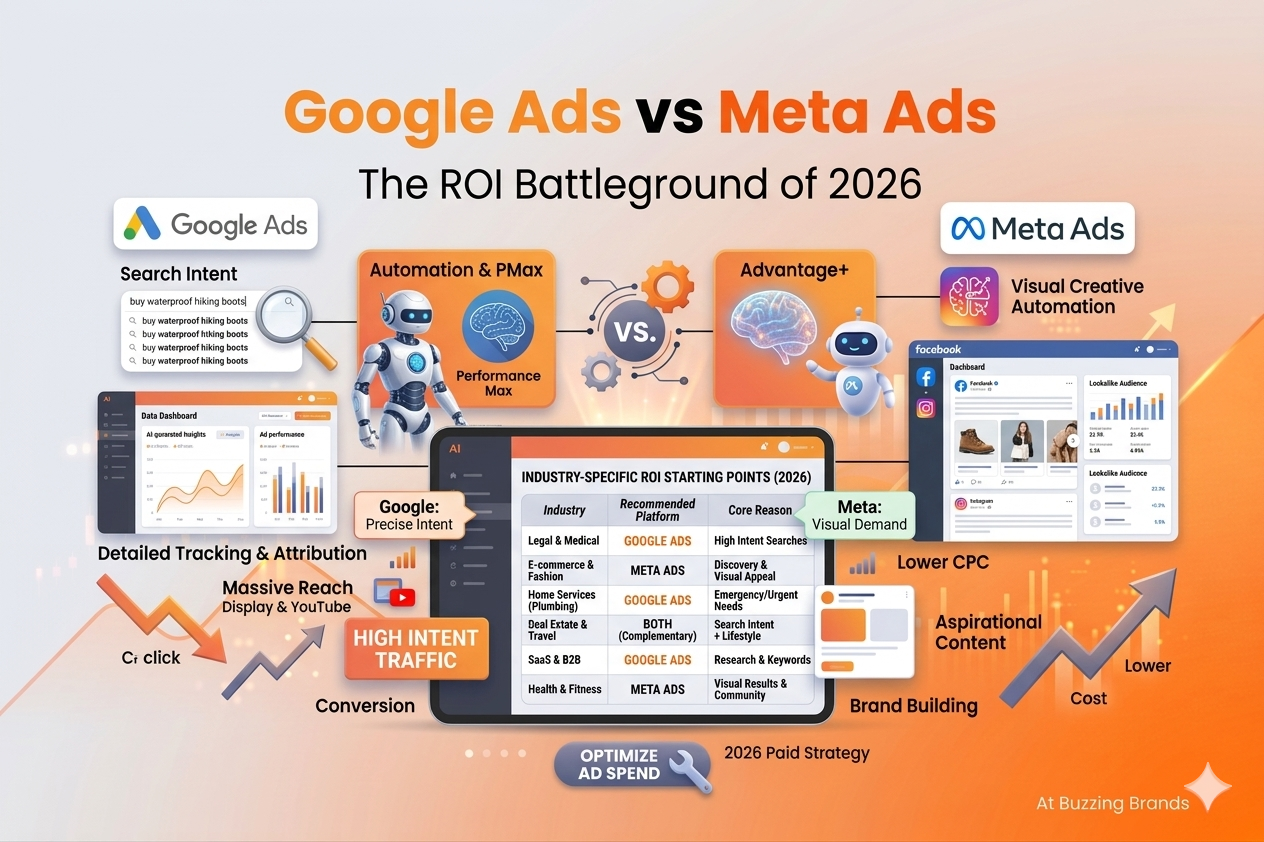
A comparison chart showing Google Ads vs Meta Ads ROI by industry.
| Industry | Recommended Starting Point | Why |
| Legal, Medical, Finance | Google Ads | High intent searches; users have urgent, specific needs |
| E-commerce / Fashion / Beauty | Meta Ads | Visual products; discovery-driven buying behaviour |
| Home Services (Plumbing, Electricians) | Google Ads | Emergency intent; users search at the moment of need |
| Food & Beverage / Restaurants | Meta Ads | Visual appeal drives interest; location-based targeting |
| B2B Software / SaaS | Google Ads | Research led buying journey; keyword targeting aligns well |
| Education / Coaching | Google Ads and Meta Ads | Google captures course specific searches; Meta builds brand |
| Real Estate | Google Ads and Meta Ads | Intent driven search combined with lifestyle based targeting |
| Travel & Hospitality | Meta Ads | Aspirational content; inspiration driven decision making |
| Health & Fitness | Meta Ads | Community driven; before and after content performs well |
Conclusion: There Is No Universal Winner
After a comparison of Google Ads vs Meta Ads, the conclusion is clear: there is no single platform that wins across every situation. The right answer depends entirely on your business goals, your audience, your product, and your funnel stage.
If you need to convert high intent users who are actively searching, Google Ads is your strongest lever. If you need to build brand awareness, reach new audiences, and generate demand for a visual product, Meta Ads is often the better starting point. If you want to maximise ROI across the full customer journey in 2026, the most powerful strategy is to run both google ads and meta ads platforms as complementary channels not competing ones.
As AI continues to reshape both platforms through Google’s Performance Max and Meta’s Advantage+ campaigns the complexity of setup is decreasing while the importance of strategy, creative quality, and measurement is increasing. The advertisers who win in 2026 will not just be the ones who spend more; they will be the ones who understand the role of each platform in their customer’s journey and align their spend accordingly.
At Buzzing Brands, we help businesses across India design and execute paid advertising strategies that deliver measurable results. Whether you are just starting out with Google Ads, scaling your Meta campaigns, or building an integrated paid media strategy , our team has the expertise to guide every step.